Feeds:
Posts
Comments

Archive for the ‘Trades’ Category

(Updated Jan. 8, 2025)

In losing their closer and top run producer within a six-day stretch in December 1984, the Cardinals appeared to be a franchise in danger of decline.

george_hendrick2Instead, they became champions.

With Bruce Sutter (45 saves, 1.54 ERA) and George Hendrick (28 doubles and 69 RBI), the 1984 Cardinals achieved 84 wins and finished 12.5 games behind the champion Cubs in the National League East.

Without Sutter and Hendrick, the 1985 Cardinals achieved 101 wins and clinched the National League pennant.

On Dec. 7, 1984, Sutter, a free agent, signed with the Braves. Five days later, on Dec. 12, 1984, the Cardinals dealt Hendrick and minor-league third baseman Steve Barnard to the Pirates for pitcher John Tudor and utility player Brian Harper.

Distraught by the trade of a player who had led the Cardinals in RBI for five consecutive years and in home runs for four seasons in a row, second baseman Tommy Herr told the St. Louis Globe-Democrat, “It’s hard to understand. I think we’ve taken some serious steps backward. … I don’t know why they would trade George, especially to a team in our division. I don’t see how our lineup can withstand the loss of a guy like George.”

Strengthen rotation

Sutter’s departure had created an urgency for the Cardinals to find a pitcher to join Joaquin Andujar as starters who could go deep into games. Without Sutter, the Cardinals are “going to have to have our starters go like hell and get us to the eighth inning,” manager Whitey Herzog told The Sporting News.

Hendrick, 35, was deemed expendable because the Cardinals believed they had candidates to replace him.

Cardinals general manager Joe McDonald told United Press International, “We are sorry to give up George Hendrick and wish him well, but young outfielders like Andy Van Slyke and, a little further into the future, Vince Coleman are deserving of their chances and I’m sure they’ll respond in a way St. Louis fans like.”

In his book “You’re Missin’ a Great Game,” Herzog said Hendrick “became one of the most respected players on my team. When I traded him to the Pirates, it was only out of baseball necessity.”

Herzog told Cardinals Magazine he considered Hendrick “a Gold Glove in right field … Never made mental mistakes, played good team baseball and really grew up to be a heck of a man.”

Cardinals outfielder Willie McGee recalled how he and Hendrick would drive home from the ballpark together during the 1984 season. “George helped me a great deal,” McGee recalled to Rick Hummel of the St. Louis Post-Dispatch. “It was like he thought more about another person than himself. I’d leave the park and I’d be down, but by the time we got home, I’d be laughing and looking forward to the next day.”

Tudor, 30, had a 12-11 record for the 1984 Pirates. McDonald noted, though, that the left-hander had yielded fewer hits (200) than innings pitched (217) and had 117 strikeouts compared with 56 walks. “What I like about him is his ratio of bases on balls to strikeouts,” said McDonald.

Positive Pirates

The Pirates, who had finished in last place in the six-team National League East in 1984, were confident Hendrick would produce runs and excite the fan base. “It was a deal that general manager Pete Peterson needed to convince Pittsburgh fans that there is a desire to improve the club,” The Sporting News reported.

Said Peterson: “Hendrick can hit 20 home runs and drive in 80 runs … I rate him as one of the best clutch hitters in the game.”

Eight days later, on Dec. 20, 1984, the Pirates acquired another run-producing outfielder, Steve Kemp, from the Yankees.

The deals, however, were busts for the Pirates and a boon for the Cardinals.

Terrific Tudor

Tudor was both the winner and the workhorse McDonald and Herzog had hoped he would be for the 1985 Cardinals. After losing seven of his first eight decisions, Tudor won 20 of his last 21. He and Andujar each had 21 wins for the 1985 Cardinals. In 36 starts, Tudor pitched 275 innings and recorded 10 shutouts. His ERA was 1.93.

In his book, Herzog said Tudor “never threw a ball over 85 mph in his life” and credited a “now-you-see-it changeup” for Tudor’s turnaround.

“John Tudor was the most amazing pitcher I ever saw,” Herzog said.

Van Slyke, 24, adequately replaced Hendrick in right field. Van Slyke had 25 doubles and his 13 home runs ranked second on the club.

Coleman, 23, was promoted from the minors in mid-April and became the everyday left fielder, igniting the offense with 170 hits and 110 steals.

First baseman Jack Clark, acquired from the Giants two months after Hendrick was traded, delivered 22 home runs and 87 RBI.

Herzog deftly handled a closer committee of Jeff Lahti, Ken Dayley, Bill Campbell and Neil Allen until rookie Todd Worrell became the stopper in September.

Danny Cox (18 wins) joined Andujar and Tudor in creating a formidable rotation that also included Kurt Kepshire (10 wins) and Bob Forsch (nine wins).

Meanwhile, the Pirates regressed. They were 57-104, finishing 43.5 games behind the 1985 Cardinals. Hendrick hit .230 with two home runs and 25 RBI in 69 games. Kemp hit .250 with two home runs and 21 RBI in 92 games.
 

Read Full Post »

(Updated Nov. 16, 2024)

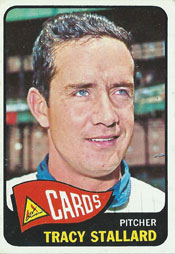
Tracy Stallard had a reputation for being a victim. The Cardinals gave him a chance to be a victor. The right-handed pitcher took advantage of the opportunity.

tracy_stallardOn Dec. 8, 1964, in one of Bob Howsam’s first deals as Cardinals general manager, St. Louis traded outfielder Johnny Lewis and pitcher Gordon Richardson to the Mets for Stallard and shortstop Elio Chacon.

The trade energized Stallard, who went from the last-place club in the National League to the newly crowned World Series champions. Stallard rewarded the Cardinals by producing the best season of his big-league career in 1965.

Until then, Stallard largely had been associated with setbacks. Most notable:

_ Roger Maris broke Babe Ruth’s single-season record when he hit his 61st home run in the 1961 season finale against Stallard at Yankee Stadium. It accounted for the lone run in a 1-0 Yankees triumph over the Red Sox. Maris accomplished one of the most memorable baseball feats. Stallard became the answer to a trivia question. Boxscore

“The pitch was a fastball and over the plate,” Maris said to the New York Times. “I appreciate the fact that he was man enough to pitch to me to try and get me out.”

Stallard told the newspaper, “I’d rather he hit the homer off me than I walk him.”

Years later, asked whether he grooved the 2-and-0 pitch to Maris to give him a shot at the record, Stallard replied to Dan Shaughnessy of the Boston Globe, “God, no … I don’t know how anybody could help anybody hit a home run … The fastball was probably all I had.”

_ Stallard had a 6-17 record for the 1963 Mets. He followed that with a 10-20 mark for the 1964 Mets and led the major leagues in losses that season. He was the starting and losing pitcher when the Phillies’ Jim Bunning achieved a perfect game against the Mets in 1964. Boxscore

“Tracy Stallard is a good pitcher,” New York Daily News columnist Dick Young wrote. “You have to be good to lose 20 games for the Mets. (Manager) Casey Stengel wouldn’t tolerate you that long if you aren’t good.”

Change of scenery

Stallard was born and raised in Coeburn, Va., a coal-mining town in the southwestern corner of the state. His father was a coal miner. “I hate the mines,” Stallard said to George Vecsey of Newsday. “Never wanted to go down there.”

Baseball gave Stallard a career path. He grew to 6-foot-5, became a standout high school pitcher and was signed at 18 by the Red Sox in 1956.

Stallard was 2-7 as a rookie for the Red Sox in 1961. On the day he gave up the home run to Maris, the Boston Patriots were playing the New York Titans in a pro football game at the Polo Grounds. According to Jerry Nason of the Globe, in the club car on the train back to Boston, a young man announced to his fellow passengers that drinks were on him. One of the Patriots players asked, “What’s this all about?” Stallard replied, “Today I became famous. Roger Maris hit his 61st homer off me.”

According to the Globe, Stallard enjoyed the good life and was known as a “real swingin’ kid” and a “member of the Red Sox jet set.” That “zest for living,” as the Globe described it, apparently hampered his pitching and he was sent back to the minors in 1962. After the season, Stallard was traded to the Mets.

According to Newsday’s Joe Donnelly, at spring training in 1964, Casey Stengel chose Stallard to manage one of the teams in an intrasquad game “because Tracy has the largest hat size (7 5/8) of any Met. Casey thinks a large head houses a large brain.”

Stallard was intelligent enough to change his pitching style in 1964, working smarter and harder to make better pitches.

“This year, he’s always thinking,” Mets catcher Jesse Gonder told Newsday in 1964. “He knows what he wants to do. He’d pitch to spots on every hitter. He wouldn’t throw the ball over the middle. He’d work on the corners. He’d always have an idea. Last year (in 1963), he was a thrower. This year, he’s a pitcher.”

Seeking a starter

Though Stallard was 1-3 against the 1964 Cardinals, he yielded just 20 hits (and no home runs) to them in 22 innings and had a 3.27 ERA.

Uncertain whether Ray Washburn would recover from a shoulder injury, Howsam sought a starter to join a rotation of Bob Gibson, Ray Sadecki and Curt Simmons.

The Mets were seeking an outfielder. Lewis, a rookie, began the 1964 season as one of the Cardinals’ regulars. He started 28 games in right field, but batted .234 with two home runs and seven RBI. In June, slowed by an ankle injury, the Cardinals sent Lewis to Class AAA Jacksonville.

Mike Shannon became the Cardinals’ right fielder and Lou Brock, acquired by the Cardinals in June 1964 from the Cubs, became the left fielder.

Bing Devine, the Cardinals general manager who engineered the deal for Brock before being fired in August 1964, had joined the Mets as an assistant to team president George Weiss. Devine recommended Lewis, 25, to the Mets. Weiss and his vice president, Johnny Murphy, negotiated with Howsam on the trade. “Devine stayed out of the picture,” The Sporting News reported.

Devine told the New York Daily News, “I’d say the only difference between Lewis and Shannon is confidence. Lewis has all the assets of Shannon, but Shannon was always confident beyond his record. Lewis never had the confidence that others felt in him.”

Stallard, who shared a midtown Manhattan apartment with Yankees infielder Phil Linz, had become “quite the young man about (town),” according to the Daily News. “He could run a charm school,” Casey Stengel told Bob Broeg of the St. Louis Post-Dispatch.

Yet, when asked his reaction to joining the Cardinals, Stallard told the newspaper, “It’s wonderful. Imagine going from a 10th-place club to a World Series winner.”

Stallard said to Newsday, “This is like going into daylight from darkness.”

Cardinals contributor

In a story headlined “Tracy Ticketed For Starter Job On Cards Staff,” St. Louis manager Red Schoendienst told The Sporting News, “Stallard is a tough competitor and he ought to do a lot better for us because our club can score some runs for him. His best pitches are a slider and a fastball.”

Said Howsam: “We wanted a fourth starter and we think we’ve got him.”

A week later, though, Howsam acquired another starting pitcher, Bob Purkey, from the Reds for outfielder Charlie James and pitcher Roger Craig.

Stallard, 27, began the 1965 season in the Cardinals’ bullpen. He lost his first start April 24 to the Reds, then won his next three decisions as a starter, beating the Pirates twice and the Dodgers. After a win over the Phillies July 18, Stallard was 7-3 with a 2.80 ERA.

His best game for the 1965 Cardinals came on Sept. 1, a day after his 28th birthday, when Stallard pitched a three-hit shutout in a 9-0 victory over the Cubs at Chicago. Stallard struck out eight and yielded only a double by Don Kessinger and singles by Joe Amalfitano and Ernie Banks. Boxscore

Stallard finished second on the 1965 Cardinals in wins (11) and third in innings pitched (194.1). His 3.38 ERA was better than the team average of 3.77. His 11-8 record represented his lone winning season in the majors.

In 1966, Stallard was 1-5 for the Cardinals, who demoted him to the minor leagues. He never returned to the majors, and thus missed a chance to be a teammate of Maris, who was acquired by the Cardinals in December 1966.

Asked about Maris, Stallard told Pat Calabria of Newsday in 1986, “I talked to him a few times after the home run. I’d see him at spring training, or someplace, and we’d talk, but we never talked about the home run … He didn’t bring it up, not once, and neither did I.”

Stallard’s big-league career totals: 30-57 record, 3.91 ERA.


Read Full Post »

(Updated May 24, 2025)

A central figure in an unpopular trade, Alvin Dark responded with a hitting display that endeared him to Cardinals fans and gained him satisfaction against his former team.

al_darkDark was a three-time all-star shortstop with the Giants and 1948 National League Rookie of the Year with the Braves. He played for 14 seasons in the major leagues and hit a combined .323 in 16 World Series games for the Braves (1948) and Giants (1951 and 1954). Dark also managed four big-league clubs, winning a pennant with the 1962 Giants and a World Series championship with the 1974 Athletics.

On June 14, 1956, Cardinals general manager Frank Lane traded second baseman Red Schoendienst, a nine-time all-star, to the Giants. The key player the Cardinals received in return was Dark.

The full trade was Schoendienst, outfielder Jackie Brandt, catcher Bill Sarni, pitcher Dick Littlefield and two players to be named (shortstop Bob Stephenson and pitcher Gordon Jones) to the Giants for Dark, outfielder Whitey Lockman, catcher Ray Katt, pitcher Don Liddle and cash.

Lane made the trade because he wanted to move Don Blasingame from shortstop to second base. He figured trading Schoendienst would land him a shortstop in return. Lane had been trying for months to get Dark.

“The Giants wanted a second baseman, the Cardinals a shortstop and everybody was pleased except the Cardinals fans, who, understandably, loved Red. He was the finest second baseman in the game,” Dark said in his book “When in Doubt, Fire the Manager.”

Said Lane to The Sporting News: “We let Schoendienst go with great reluctance, naturally, but to get a star like Dark you’ve got to give a star.”

Cardinals fans expressed their displeasure. “The switchboard at Busch Stadium lighted up like a Christmas tree and stayed that way for more than two hours June 14,” wrote The Sporting News.

Dark, 34, hit .366 in his first 28 game for the Cardinals.

On July 12, the Giants visited St. Louis for the first time since the trade. Dark had nine hits in 11 at-bats and seven RBI, sparking the Cardinals to a three-game sweep. Schoendienst had three hits in 11 at-bats and walked twice.

In the first game of the series, won by the Cardinals, 5-3, on July 12, Dark drove in the winning run with a sacrifice fly in the seventh. Boxscore

Dark drove in the winning run again in Game 2, a 7-5 Cardinals triumph on July 13. With the score tied at 5-5 in the eighth, he hit a two-run double against Hoyt Wilhelm. Boxscore

In the series finale on July 14, Dark was 3-for-3 with three RBI against starter Al Worthington in the Cardinals’ 5-2 triumph. Boxscore

Dark had seven hits in his last seven at-bats of the series.

“He’s a polished professional, a real leader who leads without being ostentatious,” Lane said.

Dark hit .286 in 100 games for the 1956 Cardinals. According to the 2004 Cardinals Yearbook, no one in the majors used a bat as light as Dark’s: 28 ounces.

In 1957, Dark batted .290. One of his best games occurred July 24 when he tripled twice _ against Sal Maglie and Sandy Koufax _ and scored twice in a 3-0 Cardinals victory over the Dodgers. Boxscore

By 1958, Dark, 36, had lost fielding range. The Cardinals had a replacement, shortstop Eddie Kasko, on the roster. Dark was traded to the Cubs on May 20, 1958, for pitcher Jim Brosnan.

Dark had 306 hits in 258 games over three seasons for the Cardinals and batted .289. He produced four hits in a game seven times.


Read Full Post »

Jerry Reuss Banner

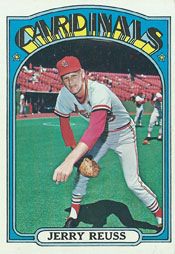
On Nov. 11, 2014, I visited the Dodgers Adult Baseball Camp at Historic Dodgertown in Vero Beach, Fla., to seek out Jerry Reuss for an interview about his time as a pitcher with the Cardinals.

Dressed in a home white Dodgers uniform, Reuss, 65, was patient, thoughtful, articulate and polite.

He debuted with the Cardinals in September 1969 and pitched for them in 1970 and 1971, posting an overall 22-22 record before he was traded to the Astros in April 1972.

In a 22-year major-league career, primarily with the Dodgers (nine years) and Pirates (six years), Reuss was 220-191 with a 3.64 ERA. In 2014, he published a book “Bring in the Right-hander,” a delightful retrospective on his career. You can order an autographed copy at his Web site www.jerryreuss.com.

jerry_reuss2Q.: Two months after the Cardinals traded Steve Carlton, they traded you. It was first reported you were traded because you were in a contract dispute with owner Gussie Busch. Later it comes out it was about your moustache. True?

Reuss: “It was about growing a moustache. Bob Broeg (a writer) had said something to that effect and I thought, ‘No, they wouldn’t be that concerned about that.’ I lived with that for 20 or 25 years.

“It wasn’t until the mid-90s when I was in St. Louis and I went to a ballgame and I saw Bing Devine, who was working as a scout. He had been the general manager of the Cardinals when I was traded. I said, ‘Bing, you got a minute?’ He said, ‘Yeah. Why don’t you sit down and we’ll talk.’ So I asked him about the deal. I figured enough time had passed that I could do that.

“He was more than happy to tell me. He said Mr. Busch at times would act on an impulse. This was one of those times. He insisted on me being traded because I had the moustache. Bing thought if given a little time he (Busch) would come to his senses and make a wise baseball decision rather than a personal decision.

“But he kept hammering about the moustache and would say, ‘Did you get rid of him yet? Why not?’ And the ultimatum was put like this: ‘If you don’t get rid of him, I’ll get rid of you and get somebody who will get rid of him.’ So when you’re faced with a situation like that, you do what has to be done.”

Q.: You still have a moustache and it has become something of a signature look for you…

Reuss: “Yeah. But when you look back about how that was the thinking in baseball in the early 70s and then just two or three years later baseball began to change with the times. Guys were coming in with long hair and beards. And you just wonder: What was the stink all about?

“So on the matter of just a little bit of facial hair _ you could barely see it _ people would ask, “Why didn’t you shave it?’ And I’d say, ‘There wasn’t a rule that the Cardinals had to be clean-shaven and be like a military situation. If it doesn’t bother anybody, if it’s not a rule, then what are we talking about here?’ ”

Q.: Your last year with the Cardinals, 1971, was the year your teammate, Joe Torre, led the National League in hitting and RBI and won the MVP Award. Could you see then the leadership qualities that later would make him a Hall of Fame manager with the Yankees?

Reuss: “Oh, sure. Lights out. At that early age, I just wondered whether there were guys like that on every team.

“He was managing the club on the field. Red (manager Schoendienst) just stepped back and said, ‘Joe, you have a grasp of it. You take care of it. When you’re on the field, you see things that I don’t.’ And Joe, being wise enough and knowing his boundaries, would go to Red and say, ‘Would you consider this or would you consider that?’

“Sometimes there was a lineup that was put out and Joe would go to Red and say, ‘This player won’t say it to you but he’ll say it to me. You might want to give him a day off.’ And Red would say, ‘All right. Let’s do that.’ He’d make the lineup change. Joe was able to get those things from players and he did it only because it helped the club. It wasn’t anything personal with the player.

“You could see the leadership. I’ve never come across another player who was like him. There were a couple that had some of those qualities _ I understand Cincinnati had a few. (Johnny) Bench was one of those guys _ that when he spoke, everybody just said, ‘Let’s reconsider this.’ Joe was that way all the time. Joe was more far-reaching. You knew he would be a manager.”

Q,: After leaving the Cardinals, you played for seven big-league teams. As a St. Louis native who began his career with the hometown team, did you ever hope to return to the Cardinals?

Reuss: “I never gave it a whole lot of thought. Once I got to Los Angeles (in 1979), I said, ‘This is home. This is where I want to be.’ It’s where I always wanted to play.

“Back in those days, it was one of the few grass fields. Lots of artificial turf then. My knees were feeling it. And then I became a ground ball pitcher and the infield I had behind me was particularly adept at playing at Dodger Stadium on the lawn.

“As a result, I had a good defensive ball club become a great defensive ball club. They got a lot of ground balls. That’s where my success was and that’s where I wanted to stay. When I was ready to change teams, I was past my prime. Rather than a lot of teams coming to me, I was going to them and just hoping for a chance.”

Q.: The player who had the most at-bats against you was

Reuss: “Pete Rose. Did you see what he hit against me?”

Q.: .244 in the regular season. (29-for-119).

Reuss: “I couldn’t believe that.”

Q.: What was your secret?

Reuss: “There was no secret. Pete hit me the same way he hit everybody else. It’s just that, when he hit the ball against me, more often it was right at somebody. Did you see the number of times he struck out against me? (9) He was making contact. He came up there swinging.”

Part 1: Jerry Reuss on Bob Gibson as a teammate: He was tough

Read Full Post »

Bing Devine thought he added the final piece to a championship contender when he acquired Gold Glove shortstop Ed Brinkman for the Cardinals. What the general manager didn’t know was he had dealt for a shortstop who did better playing on grass and dirt than on artificial turf.

ed_brinkmanFor the Cardinals, who played their home games on artificial turf at Busch Stadium, the deal was a dud.

On Nov. 18, 1974, the Cardinals, Tigers and Padres made a blockbuster trade. The Tigers sent Brinkman, outfielder Dick Sharon and pitcher Bob Strampe to the Padres for first baseman Nate Colbert. The Padres then swapped Brinkman and catcher Danny Breeden to the Cardinals for pitchers Sonny Siebert, Alan Foster and Rich Folkers.

Brinkman, who turned 33 three weeks after the deal, won a Gold Glove Award in 1972 with the Tigers when he led American League shortstops in fielding percentage (.990). Brinkman played 72 consecutive games without an error that season. He was named an American League all-star in 1973.

The Cardinals finished 1.5 games behind the first-place Pirates in the National League East in 1974 with a starting shortstop, Mike Tyson, who made 30 errors in 143 games. Tyson also struggled to stay trim. The Sporting News described him as being “built more like a catcher than a shortstop. Barrel-chested and with a belly to match.”

Moving Tyson to a utility role and adding Brinkman to a starting infield of Keith Hernandez at first, Ted Sizemore at second and Ken Reitz at third appeared to strengthen the Cardinals’ defense and give them the piece they needed to catch the Pirates in 1975.

Positive vibes

In a story headlined “Bing Beams Over Brinkman,” Devine told The Sporting News, “We now have eight solid men in our starting lineup.”

The Sporting News agreed, calling Brinkman “the experienced shortstop the Cardinals long had been seeking.”

Said Cardinals pitcher Bob Gibson: “We’re stronger at shortstop with Eddie Brinkman.”

Steady Eddie

Brinkman was a Cincinnati Western Hills High School teammate of Pete Rose. At 19, Brinkman debuted in the major leagues with the 1961 Senators. He joined the Tigers in October 1970 in the trade that sent pitcher Denny McLain to the Senators. With his steady defense, Brinkman helped Detroit win a division title in 1972.

Tigers general manager Jim Campbell called Brinkman “one of the finest professional players I’ve ever been around in my life.”

Detroit correspondent Jim Hawkins described Brinkman as “one of the best shortstops ever to wear a Detroit uniform.”

Good start

The early reviews about Brinkman with the Cardinals were encouraging. He asked for and was issued uniform No. 5 because he said it was the number closest to the No. 6 worn by two of his favorites, Stan Musial of the Cardinals and Al Kaline of the Tigers.

Brinkman hit .355 in spring training exhibition games for St. Louis. He produced RBI in five of six regular-season games from April 11 through April 18.

After 17 April games for the Cardinals, Brinkman was batting .283.

Plastic grass

Rather than solidify the shortstop position, though, Brinkman weakened it. Getting to balls on the lightning-quick artificial turf was far different than fielding on grass and dirt.

“The Cardinals quickly became disenchanted with Brinkman, who was accustomed to the real grass in the American League,” The Sporting News reported.

Brinkman started 24 games at shortstop for the 1975 Cardinals and committed six errors, five on artificial turf.

Cardinals manager Red Schoendienst reinstated Tyson as the starting shortstop on May 5. Later that month, Mario Guerrero, acquired in April from the Red Sox, became the starter. Brinkman, who made three errors in seven May games, was relegated to the bench.

Devine, admitting he had erred but noting there had been a robust market for the shortstop, said, “A lot of other people were fooled about Brinkman.”

Sent packing

On June 4, 1975, the Cardinals traded Brinkman and pitcher Tommy Moore to the Rangers for outfielder Willie Davis. Brinkman played one game for the Rangers and was dealt to the Yankees for cash. The Rangers needed the money to swing a deal with the Indians for pitcher Gaylord Perry.

The 1975 Cardinals tied for third in the National League East, 10.5 games behind the champion Pirates.

During spring training in 1976, the Yankees released Brinkman, ending his playing career.

Seven years later, in 1983, Brinkman became a coach under White Sox manager Tony La Russa, joining a staff that included Dave Duncan and Jim Leyland. Brinkman remained with the White Sox after Jim Fregosi replaced La Russa in June 1986. He coached until 1988, became a scout and worked for the White Sox until he retired in 2000.


Read Full Post »

(Updated Sept. 9, 2025)

Unable to supplant Lou Brock, Bake McBride or Reggie Smith, outfielder Jose Cruz left the Cardinals in 1974 and fulfilled his potential with the Astros.

jose_cruzThough he’d been a sensation in the minors and Puerto Rican winter league, Cruz, a left-handed batter, struggled with the Cardinals after debuting with them in 1970. His stock dropped so low that the Cardinals didn’t get anyone in return for him.

Instant upgrade

On Oct. 24, 1974, the Cardinals sent Cruz, 27, to the Astros in a cash transaction for $25,000.

A grateful Preston Gomez, the Astros’ manager, told The Sporting News, “This boy Cruz is better than anybody we had on the ballclub last year. He can hit with power, has better than average speed and he has a good arm.”

(Gomez had his eye on Cruz for several years. In 1971, as manager of the Padres, Gomez told the St. Louis Post-Dispatch he was impressed by Cruz and teammate Luis Melendez. “I like Cruz the best of the lot,” Gomez said of the Cardinals outfield prospects in April 1971. “Melendez is quite a ballplayer, too … I’d take either him or Cruz right now. I wish we had something to offer the Cardinals.”)

Cruz told the Houston Chronicle, “I can hit .300 if I play regularly.”

Cruz spent 13 seasons with the Astros, batting .292 with 1,937 hits in 1,870 games. He twice was named a National League all-star (1980 and 1985), won two Silver Sluggers awards (1983-84), led the league in hits (with 189 in 1983) and helped the Astros to the first three postseason appearances in franchise history.

Struggles in St. Louis

Though impressed by his range and arm, the Cardinals had found Cruz to be an undisciplined hitter, who regularly swung at bad pitches.

Cruz made 89 outfield starts for the 1972 Cardinals and batted .235. In 1973, he made 110 outfield starts for St. Louis and hit .227.

By 1974, Cruz was relegated primarily to being a pinch-hitter and late-inning defensive replacement. He made 25 outfield starts for the 1974 Cardinals and batted .261. He hit .217 as a pinch-hitter that season.

Forgotten man

“The Redbirds had been losing patience with Cruz, who seemed to be leaving too many hits in the winter leagues,” The Sporting News reported.

With Jerry Mumphrey, Jim Dwyer and Larry Herndon also vying for outfield playing time, the Cardinals deemed Cruz expendable. The Sporting News described Cruz as “a forgotten man” most of the 1974 season.

In five seasons with the Cardinals, Cruz batted .247 with 298 hits in 445 games, 26 home runs and 128 RBI.

With Bob Watson moving from the outfield to first base, Cruz was handed the Astros’ starting right field job in 1975. Gomez was fired that season _ he became a Cardinals coach for manager Red Schoendienst in 1976 _  but Cruz remained a starting outfielder for Houston every season through 1987.

Meanwhile, the Cardinals ended up with a void in right field. Reggie Smith was traded to the Dodgers in 1976. The Cardinals tried Hector Cruz, Jose’s brother, as the right fielder in 1977 and Jerry Morales in 1978. It wasn’t until 1979, when George Hendrick took over, that the position stabilized.

Recalling his Cardinals days, Cruz said to Bernie Miklasz of the Post-Dispatch in 1985, “I don’t know if I really had the chance here (in St. Louis), but … the Cardinals did me a favor by sending me to Houston. I got a chance there.”

In May 1988, Jack Clark, a slugger on two Cardinals pennant-winning clubs (1985 and 1987), told Kenny Hand of the Houston Post, “Jose Cruz never got the recognition he deserved. He swings the bat like George Brett. He has been one of the best hitters in the game. I consider myself a good hitter. Jose Cruz is a great hitter. He’s always looked so natural, used the whole field. I have power, but if I could do everything he can do I’d be a great hitter.”


Read Full Post »

« Newer Posts - Older Posts »