Feeds:
Posts
Comments

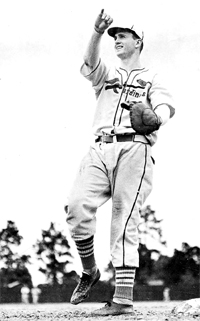
While pitching in the Cardinals’ organization, Pete Mazar became known as much for his vocal cords as for his arm.

Dubbed the “Frank Sinatra of baseball” for his singing, Mazar, like Ol’ Blue Eyes, was from New Jersey. Sinatra’s hometown was Hoboken, site of the first organized baseball game played in 1846 between the Knickerbocker Club and New York Nine. Mazar grew up in High Bridge, a mere 50 miles from Hoboken but, otherwise, worlds apart.

An urban melting pot across the Hudson River from Manhattan, Hoboken in Sinatra’s time was known for its gritty industrial docks and was the setting for the film “On the Waterfront.” In contrast, the borough of High Bridge has a reputation as a place for parks, trails and scenic beauty. A resident, Howard Menger, wrote “The High Bridge Incident,” a book about his claim of having met space aliens in the woods near High Bridge when he was a boy. Otherworldly, indeed.

Little lefty

Pete Mazar had eight brothers (including a twin) and five sisters, according to The Sporting News. Though no more than 5-foot-9 and 150 pounds, he was a standout athlete in soccer, basketball and baseball at High Bridge High School.

After graduation in June 1940, Mazar was a machinist for the local Taylor-Wharton Iron and Steel Company, makers of railroad fittings and switches and dredging equipment. A left-handed pitcher, he played semipro baseball for the High Bridge team in the well-regarded Tri-County League.

Mazar’s success as a semipro player got him a contract in 1941 with a New York Giants farm club in Milford, Del., but he became ill, pitched briefly and got released, according to the Allentown (Pa.) Morning Call. Returning to High Bridge, Mazar went back to the iron and steel job (the company now was producing material for America’s World War II involvement) and pitched semipro baseball.

In May 1944, with the war depleting baseball team rosters, the Cardinals offered Mazar, 23, a tryout with their Allentown farm club. Allentown manager Ollie Vanek, who had a notable eye for talent (the Cardinals signed 16-year-old Stan Musial on Vanek’s recommendation), took one look at Mazar and gave him a spot on the team. Mazar rewarded him with an 11-6 record.

Promoted by the Cardinals to Columbus (Ohio) in 1945, Mazar pitched a no-hitter against manager Casey Stengel’s Kansas City Blues. Of the 27 outs Mazar recorded using a sharp-breaking curve, 20 came on grounders, the Kansas City Times reported.

American idol

Seven of Mazar’s eight seasons in the Cardinals’ system were spent either with Columbus or Houston. In 1947, he pitched for both. After going 0-4 for Columbus, he was sent to Houston and pitched better for manager Johnny Keane’s club, which was on its way to becoming Texas League champions.

On Aug. 19, 1947, an estimated 13,000 spectators packed into Houston’s Buffalo Stadium for a doubleheader on what was promoted as “appreciation night.” Looking for ways to show their appreciation to fans, club officials gave Mazar a microphone before one of the games and asked him to sing for the crowd. Mazar had “served as a vocalist in a nightclub near his home at High Bridge,” according to The Sporting News.

Crooning hit tunes, Mazar thrilled his audience and was touted as “the Sinatra of baseball,” the Associated Press reported. (Sinatra’s popular songs in 1947 included “Almost Like Being in Love,” “Autumn in New York,” and “Time After Time.”)

Word spread that the Houston club had a silky-voiced troubadour with a smooth delivery. “Now everywhere he goes to play ball, they want him to warble,” according to the Associated Press.

On Aug. 24, it was arranged for Mazar to sing a song before Houston’s game at Dallas. “The crowd of 6,000 roared its approval,” the Associated Press reported. “They called him back for another, and still another. They wanted him for a fourth except that the ballgame had to go on.”

The next night, Aug. 25, Mazar was the starting pitcher for Houston at Oklahoma City. He entertained a crowd of 4,937 with three songs, then got the win against an Oklahoma City club that featured hitters such as Ray Boone and Al Rosen.

Houston club president Allen Russell asked Mazar to spend the winter in Texas so that he could promote his singing.

Fan favorite

Back with Houston and Johnny Keane in 1948, Mazar, 27, had his best season as a pitcher. He won 12 of his first 14 decisions and finished 15-10 with a 2.53 ERA in 228 innings.

His most satisfying win came at home on July 17, 1948. When Houston fans learned Mazar and his wife were expecting their third child, they presented the couple with more than 100 gifts before that night’s game. Mazar thanked the crowd of 7,358, crooned several songs and then pitched a three-hit shutout to beat Tulsa. “I never wanted to win a game so much in my life … I didn’t want to let all of those good people down,” Mazar told The Sporting News.

Mazar’s successful 1948 season didn’t do enough to impress the Cardinals. When they didn’t put him on their 40-man winter roster, the Cubs claimed him in the November 1948 minor-league draft on the recommendation of scout Jigger Statz. Mazar reminded him of Tony Freitas, another pint-sized left-hander who pitched in the majors during the 1930s, Statz told the Los Angeles Times.

Assigned to the Cubs’ Los Angeles Angels farm team in 1949, Mazar was 2-4 for the Pacific Coast League team when he got sent back to Houston in May.

In April 1950, Mazar was struck by a line drive, breaking his left thumb. It didn’t hurt his singing, but it did his pitching. The 1951 season was Mazar’s last in the Cardinals’ system. He pitched three more years in the minors but never reached the big leagues _ either as a player or a singer.

Returning to High Bridge, Mazar and his wife operated a tavern and he also worked as a machinist for F.L. Smidth & Company, makers of equipment for mining and cement industries.

One year after they traded Steve Carlton because he wanted a $65,000 salary, the Cardinals offered a college pitcher a six-figure contract.

Michigan State’s Brad Van Pelt, a right-hander with a 100 mph fastball, was the prospect who prompted the Cardinals to consider coughing up the cash. He also was a football talent, a recipient of the Maxwell Award presented to the most outstanding college player in the sport.

Drafted in January 1973 by the baseball Cardinals and the NFL New York Giants, Van Pelt opted for pro football. He went on to play 14 seasons, helping to form one of the all-time best linebacking units.

Abundant athleticism

Van Pelt was from Owosso, Mich., a town 90 miles northwest of Detroit. Thomas Dewey, twice the Republican nominee for president, was from there, too. (Dewey lost to Franklin Delano Roosevelt in 1944 and to Harry Truman in 1948.)

An athlete who excelled in every sport he tried, including bocce, golf and soccer, Van Pelt was a high school sensation as a quarterback in football, a rebounder in basketball (he hauled down 42 in one game) and a pitcher in baseball (consecutive no-hitters as a senior).

The Tigers, his favorite team, chose Van Pelt, 18, in the 14th round of the 1969 June baseball draft but he took a football scholarship from Michigan State instead.

(It was the first of five times Van Pelt was selected in the baseball draft. He declined to sign each time. After the Tigers in June 1969, others to draft him were the Angels in June 1972, Cardinals in January 1973, Pirates in June 1973 and Indians in January 1974.)

“Rangy, fast and strong,” Van Pelt, 6-foot-5, 220 pounds, had the “defensive end’s body with the receiver’s speed,” according to the Lansing State Journal.

Michigan State guard Joe DeLamielleure (elected to the Pro Football Hall of Fame for his skill as a Buffalo Bills and Cleveland Browns lineman) told the newspaper, “Van Pelt was the modern day Jim Thorpe, and that’s no exaggeration … He could have been our starting quarterback because he could throw the ball a mile.”

Michigan State head coach Duffy Daugherty said Van Pelt could have played any position on the football team. “He is the most versatile athlete I’ve ever coached,” Daugherty told the Associated Press.

Daugherty dubbed Van Pelt his “secretary of defense” and put him at safety. Often called a rover back, Van Pelt had the size and speed to intimidate receivers, stuff rushers and pressure quarterbacks with blitzes. “I’ve never seen a safety able to come up to the line of scrimmage to make tackles as quick as Brad can,” Daugherty said to the Flint Journal.

George Perles, an assistant on Daugherty’s staff before eventually becoming head coach, told the Lansing newspaper, “During his college career, he (Van Pelt) might have been the biggest safety in the Big Ten (Conference), if not the country.”

In his three varsity seasons (1970-72), Van Pelt totaled 256 tackles and 14 interceptions. “He (Daugherty) gave me the freedom to blitz when I wanted and to go to the ball on every play,” Van Pelt said to the State Journal. “I can’t thank him enough.”

Man for all seasons

Described by Joe Rexrode of the Lansing newspaper as “the purest all-around athlete in Michigan State history,” Van Pelt played varsity basketball and baseball.

He got into 31 basketball games for head coach Gus Ganakas, who told the State Journal, “Van Pelt helped define the position of power forward.”

In baseball, Van Pelt pitched for head coach Danny Litwhiler, a former big-leaguer who played in two World Series (1943 and 1944) as the Cardinals’ left fielder.

As a sophomore, Van Pelt was on the 1971 Big Ten championship baseball team. The next season, he struck out 84 in 56.1 innings and had a 2.07 ERA. The Angels picked Van Pelt in the 13th round of the June 1972 draft and offered $100,000 _ “The first three days after they made the offer I really thought about signing,” Van Pelt told the Flint Journal _ but he chose to return to college for senior year.

Instead of spending the summer of 1972 pitching in the Angels’ system, Van Pelt went to the Netherlands with an amateur team from Grand Rapids, Mich., to compete in an international honkbal (Dutch for baseball) tournament.

Cardinals calling

After Van Pelt’s senior football season, big-league baseball held a winter draft on Jan. 10, 1973. In those days, a secondary phase was conducted for players who had been drafted in prior years but hadn’t signed.

Selecting seventh in the first round, the Cardinals chose Van Pelt. “He was one of a few premium players available,” Cardinals director of player procurement George Silvey told the St. Louis Post-Dispatch.

Cardinals general manager Bing Devine said to United Press International, “He’s an all-American boy in every sense of the word.”

(The Tigers, who had the next pick after the Cardinals, were planning to draft Van Pelt, the Post-Dispatch reported. When the Cardinals beat them to it, the Tigers went with Van Pelt’s Michigan State teammate, pitcher Larry Ike.)

Van Pelt told the Cardinals he’d wait until the NFL draft was held on Jan. 30, 1973, before making a decision.

When the Cardinals made it known they intended to sign Van Pelt, NFL teams didn’t want to risk losing a first-round pick in a bidding war with a baseball team. As the New York Times put it, Van Pelt became “a player of unquestioned ability but highly questionable availability.”

New York Jets head coach Weeb Ewbank told the Times, “We just didn’t see any sense in fighting baseball for him, but he is one hell of an athlete.”

The Giants, who had traded their first-round pick to the Browns for defensive end Jack Gregory, grabbed Van Pelt in the second round, where, as head coach Alex Webster noted to the Times, “he was worth the risk.”

Decision time

A year earlier, the Cardinals reportedly offered Steve Carlton a 1972 salary of $57,500. Carlton wanted more. As spring training got under way, Carlton said he and the club were less than $10,000 apart, The Sporting News reported, but owner Gussie Busch, angry when the pitcher didn’t sign, ordered Bing Devine to trade him. Carlton was sent to the Phillies, who gave him $65,000 in 1972, and he won 27 games for them that season.

Devine offered a lot more than that to Van Pelt in February 1973. Braving a snowstorm, Devine met with Van Pelt in Owosso and made an enticing pitch. “We went to a peak level with the offer we made him,” Devine told Milton Richman of United Press International. “By that I mean over $100,000.”

Giants owner Wellington Mara followed Devine to Owosso and presented Van Pelt with a three-year, no-cut contract worth $300,000.

Van Pelt said the money offered by the Cardinals and Giants was about the same. “The two offers were so close that I almost thought they had gotten together,” he remarked in an article published in the Post-Dispatch.

Van Pelt chose the Giants primarily because he could begin his pro career in the NFL rather than in baseball’s minor leagues.

(Danny Litwhiler told United Press International that Van Pelt would need at least two years of total concentration on baseball to become ready for the majors. Van Pelt acknowledged to the Jersey Journal, “I know I have a major-league fastball, but my curve leaves a lot to be desired.”)

As Devine said to Milton Richman, “With us, he would have had to go to the minor leagues to develop. With the football Giants, he went right to the big-league club. That was the key.”

Crunch Bunch

The Giants tried Van Pelt at tight end and strong safety during a frustrating rookie year. After Bill Arnsparger replaced Alex Webster as head coach in 1974, Van Pelt shifted to outside linebacker. His career soared when Marty Schottenheimer arrived as linebacker coach in 1975. “I’d say 85 percent of what I am now, I learned from him,” Van Pelt told the Detroit Free Press in 1979.

Van Pelt was named to the Pro Bowl five years in a row (1976-80) and was chosen as the Giants’ player of the decade for the 1970s. “If Brad Van Pelt played on a good team, he would be a household name,” Los Angeles Rams general manager Don Klosterman said to Mike Lupica of the New York Daily News.

The Giants had one winning record in Van Pelt’s 11 seasons with them. As club executive John Mara told the Daily News, “If you look at those (Van Pelt) years, our teams were as bad as could possibly be. We really had some awful teams in the 1970s. He was the one guy who was consistently a good player.”

Van Pelt played for five Giants head coaches _ Alex Webster, Bill Arnsparger, John McVay, Ray Perkins and Bill Parcells. (Bill Belichick was a Giants assistant coach from 1979-84 and Van Pelt’s linebacker coach from 1980-83.)

When Parcells joined the Giants as defensive coordinator on Perkins’ staff in 1981, he installed a 3-4 defense after the club drafted Lawrence Taylor. From 1981-83, the Giants’ four hard-hitting starting linebackers _ Harry Carson, Brian Kelley, Taylor and Van Pelt _ became known as the Crunch Bunch. (Carson and Taylor were elected to the Pro Football Hall of Fame.)

According to Newsday, Taylor called Van Pelt “one of the greatest players I ever played with.”

The arrival of linebacker Carl Banks, a first-round pick from, of all places, Michigan State in 1984 prompted the Giants to break up the Crunch Bunch. In July 1984, Van Pelt was traded to the Minnesota Vikings for fullback Tony Galbreath.

Van Pelt refused to report, telling the Vikings he preferred to be with a team either in California or Florida. He never played a game for the Vikings. They traded him to the Los Angeles Raiders for two draft choices. Van Pelt spent two seasons (1984-85) with the Raiders and one (1986) with the Browns.

In 1998, Van Pelt returned to Michigan State and completed his school work, earning a degree in health and physical education. Three years later, he was inducted into the College Football Hall of Fame. A son, Bradlee, was a quarterback for Colorado State and played in three games for the 2005 Denver Broncos.

In a fundraising game to honor the memory of slain civil rights activist Dr. Martin Luther King Jr., two of the top performers on a genuine field of dreams were Cardinals Lou Brock and Bob Gibson.

On March 28, 1970, the East-West Major League Baseball Classic was played at Dodger Stadium in Los Angeles. According to the National Baseball Hall of Fame, the Saturday afternoon exhibition netted more than $30,000 for two beneficiaries:

_ Southern Christian Leadership Conference, a regional organization founded by King and others in 1957 to help coordinate grassroots efforts in civil rights and voting rights activities.

_ Martin Luther King Jr. Center for Nonviolent Social Change, also known as King Center. Located in Atlanta, the center was founded in 1968 by Coretta Scott King to preserve and advance her husband’s legacy. It houses a library, archives and exhibits. It’s also the burial site of Dr. King and his wife.

Most of baseball’s top players participated in the game, taking time out from spring training to show their support for King and his mission.

Baseball tribute

After King was assassinated on April 4, 1968 (the convicted murderer, James Earl Ray, was born in Alton, Illinois, 20 miles north of St. Louis), Bob Gibson spoke with emotion about the bitterness and frustration he felt. In his autobiography, “Stranger to the Game,” Gibson said, “I reeled from the impact of the assassination _ the cold-blooded murder of the one man in my lifetime who had been able to capture the public’s attention about racial injustice, break through some of the age-old social barriers and raise the spirits and hopes of black people across the country.”

According to the Baseball Hall of Fame, shortly after King was killed, ballplayers asked King’s associates what they could do as a public tribute to him, Joseph Peters, sports project director for the Southern Christian Leadership Conference, explained in a November 1968 letter to baseball commissioner William Eckert.

When Southern Christian Leadership Conference members suggested a fundraising game, Major League Baseball officials agreed to cooperate. The game initially was planned for March 1969, but the Southern Christian Leadership Conference asked for more time. That’s why the event was held in March 1970.

Though spring training exhibitions were under way, every big-league team made players available for the fundraising game and paid their expenses, the Associated Press reported.

Among those who came to Los Angeles to play were Hank Aaron, Ernie Banks, Johnny Bench, Lou Brock, Orlando Cepeda, Roberto Clemente, Bob Gibson, Reggie Jackson, Al Kaline, Willie Mays, Joe Morgan, Tony Oliva, Frank Robinson, Pete Rose, Ron Santo, Tom Seaver and Willie Stargell.

Mays traveled from Japan, where his club, the Giants, were playing goodwill games. In explaining why he made the long trip to Los Angeles, Mays told the Torrance Daily Breeze, “This cause is too important to pass up. At last, baseball players can show their feelings about the late Dr. King and his work through the medium of this game. I wouldn’t miss it.”

Players from the East divisions of the American and National leagues were placed on an East team. The West team had players from the West divisions of both leagues. That gave fans the chance to see Angels and Dodgers, Mets and Yankees, and Athletics and Giants perform as teammates.

Joe DiMaggio was chosen to manage the East team. His coaching staff: Billy Martin, John McNamara, Stan Musial and Satchel Paige.

The West team manager was Roy Campanella. His coaching staff: Don Drysdale, Elston Howard, Sandy Koufax and Don Newcombe.

Entertainer Bill Cosby held a reception for the teams at the Warner Brothers Studio the night before the game, the Los Angeles Times reported.

Star power

Starting lineups were selected by members of the Los Angeles-Anaheim chapter of the Baseball Writers Association of America and the Southern California Sportscasters Association.

The East batting order: 1. Ron Fairly, first base; 2. Reggie Smith, center field; 3. Frank Robinson, right field; 4. Willie Stargell, left field; 5. Ron Santo, third base; 6. Ernie Banks, shortstop; 7. Don Buford, second base; 8. Tim McCarver, catcher; 9. Tom Seaver, pitcher.

Banks, 39, a Cubs first baseman, was at shortstop for the first time in nine years.

East bench warmers included Lou Brock, Roberto Clemente and Al Kaline.

The West batting order: 1. Maury Wills, shortstop; 2. Pete Rose, center field; 3. Hank Aaron, left field; 4. Reggie Jackson, right field; 5. Johnny Bench, catcher; 6. Orlando Cepeda, first base; 7. Joe Morgan, second base; 8. Sal Bando, third base; 9. Don Wilson, pitcher.

Willie Mays and Tony Oliva couldn’t crack the starting lineup.

Ticket prices ranged from $10 to $2. Among the 31,694 spectators for the 2 o’clock game were baseball pioneers Jackie Robinson and Larry Doby, baseball commissioner Bowie Kuhn (successor to William Eckert) and entertainers Sammy Davis Jr. and Danny Kaye.

Mudcat Grant sang the national anthem, a recording of Dr. King’s “I Have A Dream” speech was played on the public address system, and Coretta Scott King threw the ceremonial first pitch to Johnny Bench.

(Bench, 22, impressed fellow catcher Roy Campanella, who told the Los Angeles Evening Citizen News, “Now there’s a kid who has it all. His future is unlimited.”)

A scheduled home run hitting contest featuring Frank Robinson, Ron Santo and Willie Stargell for the East versus Hank Aaron, Orlando Cepeda and Reggie Jackson for the West was canceled without explanation, the Long Beach Independent reported.

Aces prevail

The East’s pitching combination of Tom Seaver and Bob Gibson kept the West from scoring.

When Pete Rose batted in the first, Seaver surprised him with a blooper pitch. As Rose watched it drop into catcher Tim McCarver’s mitt, plate umpire Emmett Ashford gave his emphatic “stee-rike-ah” call. Rose stepped out of the box and smiled at Seaver, who grinned back. “It was a little slip curve,” Seaver told the Long Beach Independent. Rose finished the at-bat by flying out to left.

Seaver completed his three-inning scoreless stint with back-to-back strikeouts of Pete Rose and Hank Aaron. Then Bob Gibson took over and also held the West scoreless for three innings. The only hit against Gibson was a Sal Bando single.

Despite his performance, Gibson told Rich Roberts of the Long Beach Independent, “I sure didn’t feel good. I wouldn’t be telling no lie. I just used fastballs, but you better call them straight balls because they weren’t very fast.”

The East went ahead, 1-0, in the third when Ron Fairly hooked the first pitch from Lew Krausse into the stands in right, just inside the foul pole, for a home run. Ron Santo made it 2-0 when he led off the fourth with a homer to left against Krausse.

(Krausse was representing the Seattle Pilots, who were only a few days away from becoming the Milwaukee Brewers.)

Both managers substituted often, trying to get as many players as possible into the game. In a pinch-hit appearance, Willie Mays grounded into a force out.

The East went up 5-0 with three runs in the eighth against Mudcat Grant. After Al Kaline singled, Lou Brock lined a shot that carried over the head of left fielder Hank Aaron for a run-scoring double. A Roberto Clemente smash that eluded Maury Wills was ruled a double and scored Brock. Ken McMullen drove in Clemente with a single.

Facing Grant Jackson in the bottom half of the inning, the West scored a run when Willie Davis singled and came home on a Ken Berry double.

The East won, 5-1, but it wasn’t the outcome that mattered.

“I thank these fellows for giving their time,” West manager Roy Campanella told the Long Beach Independent.

As Pete Rose noted in a column he did for the Cincinnati Enquirer, “Even though it was an exhibition game, it had meaning … I feel good inside because I’ve contributed to a worthy cause.”

Manny Lee was a one-of-a-kind Cardinal.

In the long history of the franchise, Lee is the only Cardinal to play in just one game for them and have a 1.000 batting average.

A 10-year veteran of the American League and shortstop for the 1992 World Series champion Blue Jays, Lee made his Cardinals debut as their 1995 Opening Day second baseman _ and never appeared in another big-league game.

Caribbean to Canada

Manuel Lora Lee was from San Pedro de Macoris, a Dominican Republic city noted for its poets and baseball players. Joaquin Andujar, Rico Carty, Pedro Guerrero, Alfonso Soriano, Sammy Sosa, Fernando Tatis and his son, Fernando Tatis Jr., are some of the many big-league players who came from there.

Lee was 16 when Mets scout Eddy Toledo signed him for $2,000 in May 1982. A switch-hitting shortstop, Lee led the Class A South Atlantic League in hitting (.330) in 1984, his third season in the Mets’ farm system.

To get Ray Knight from the Astros, the Mets sent them Lee and two other prospects near the end of the 1984 season. When the Astros neglected to place Lee on their 40-man winter roster, the Blue Jays claimed him in December 1984.

Boston Globe columnist Peter Gammons noted, “Houston was furious that the Blue Jays took Manny Lee, but if he were one of the best prospects in the Astros’ organization, why didn’t they protect him?”

Rules required the Blue Jays to keep Lee in the big leagues in 1985, or offer him back to the Astros. When Lee, 19 reported to the Blue Jays at 1985 spring training, he weighed 141 pounds on a 5-foot-9 frame, the Toronto Star reported, but he showed enough in the field to make the jump from Class A to the majors. He was the only teen on a 1985 big-league Opening Day roster.

Used mostly as a defensive replacement and pinch-runner, Lee produced no RBI in 40 at-bats and had more strikeouts (nine) than hits (eight). Looking back on that rookie season, Lee told the Star, “I was too young. I was like a little baby.”

Infield shift

Shortstop was the position Lee liked best, but an all-star, Tony Fernandez, had that role with the Blue Jays. After splitting time between the majors and minors in 1986 and 1987, Lee became the Blue Jays’ second baseman in 1988. He hit .291 overall and .316 with runners in scoring position that season.

Though he led American League second basemen in fielding percentage in 1990, Lee sometimes bailed out on double play pivots and was criticized for “indifferent play,” according to the Star.

When the Blue Jays acquired second baseman Roberto Alomar from the Padres after the 1990 season in a trade that included Tony Fernandez, manager Cito Gaston chose Lee to be the shortstop. “We’ve got confidence in Manny,” Gaston told the Star. “He played a decent second base for us, and he was improving, but I think shortstop was in his heart. He loves playing shortstop. Now he’s got the job.”

Star columnist Dave Perkins wrote, “Returning to his natural position should take the whitecaps off Manny’s brainwaves; he never did take to second base, or at least the idea of it.”

At 1991 spring training, the Star described Lee as “the happiest Blue Jay in camp.”

The good vibes didn’t last throughout the season, though. Lee swung like a slugger, but became the first big-league player with 100 or more strikeouts (107) and no home runs.

Blue Jays fans booed “the much-maligned and often maddening shortstop,” the Star reported.

Highs and lows

Larry Hisle joined the 1992 Blue Jays as hitting coach and said the flaw in Lee’s batting approach was obvious. “There is a lot of movement in the upper body,” Hisle told the Star. “On some pitches, his head moves as much as 12 inches.”

At spring training, “I have spent more time with (Lee) than with any other player,” Hisle said. “He has listened and he has worked. I’m urging him to concentrate on putting the ball in play.”

Lee improved, producing a career-best .343 on-base percentage and hitting .330 with runners in scoring position for the 1992 Blue Jays. He also achieved the second-highest fielding percentage among American League shortstops and didn’t commit an error on a ground ball all season. According to the Star, Blue Jays coach Gene Tenace called Lee “one of the unsung heroes of this team.” Lee credited Hisle. “He gave me confidence,” Lee told the newspaper.

In Game 3 of the playoffs against the Athletics, Lee’s two-run triple with two outs in the seventh propelled the Blue Jays to victory. They went on to win the pennant and the World Series championship. Boxscore

Granted free agency, Lee got a two-year guaranteed $3.4 million contract from the Rangers, but his time in Texas didn’t begin well. In 1993, he clashed with manager Kevin Kennedy and had what the Fort Worth Star-Telegram described as “an injury-riddled, error-prone, turmoil-laden debut season with the Rangers.”

The next year, strike-shortened 1994, Lee did better. He hit .278 (second-best batting average of his big-league career) and .337 with runners in scoring position. Though primarily the shortstop, Lee also played second base for the first time in four years and made no errors in 108.1 innings there.

Opening and closing

The Cardinals took notice. After the strike ended on April 2, 1995, the Cardinals went looking for infield help. On April 18, a week before the start of the season, they signed two free agents _ Lee and Luis Rivera _ and had them compete for a spot on the Opening Day roster. Lee won the job, expecting to back up Ozzie Smith at short and Geronimo Pena at second.

However, two days before the season opener, Pena pulled a hamstring running to second base _ on a ground-rule double. Manager Joe Torre picked Lee, 29, to replace him.

“I never thought that I would be the Opening Day second baseman,” Lee said to the Belleville (Ill.) News-Democrat. “I feel comfortable here, relaxed. There’s no pressure on me any more.” He also told the newspaper that playing alongside Ozzie Smith was “a dream for me.”

The dream turned into a nightmare, though, in the season opener against the Phillies at St. Louis.

In batting practice, Lee’s line drive struck coach Gaylen Pitts in the chest. Though Pitts wasn’t seriously hurt _ “It didn’t get me in the heart,” he told the St. Louis Post-Dispatch. “My heart is not big enough.” _ it was an omen of bad things ahead for Lee.

In the second inning, Phillies catcher Darren Daulton got an infield single on a ball Lee backhanded but couldn’t get out of his glove in time. In the third, pitcher Curt Schilling also got an infield hit on a bouncer to Lee, who again had trouble releasing the ball after fielding it and threw low and late to first.

Later in the inning, with Mickey Morandini the runner on second, Gregg Jefferies hit another bouncer toward Lee. “The ball glanced off the glove of Lee, who reached for it again and then tumbled flat on his back,” the Post-Dispatch reported. “Morandini, who had held at third, motored home” and Jefferies reached first on the error.

Adding injury to insult, Lee sprained his right ankle on the play. He received medical attention but stayed in the game.

Asked whether he should have made the plays on the grounders hit by Daulton, Schilling and Jefferies, Lee told the Post-Dispatch, “I used to, but I haven’t played second base for a full year.”

Leading off the bottom of the third in his first Cardinals plate appearance, Lee singled to left and eventually scored on a Scott Cooper single. After the inning, Lee was unable to continue on the sprained ankle and was replaced at second by Jose Oquendo.

Rick Hummel of the Post-Dispatch wrote, “It’s fairly probable that the Manny Lee Show at second base will have a short run.” Boxscore and Video

More to the story

Lee was placed on the 15-day disabled list and the Cardinals called up Tripp Cromer from the minors to replace him.

When Lee’s ankle healed, he played in 12 games for Cardinals farm clubs on an injury rehabilitation assignment. Ready to rejoin the Cardinals, he returned to St. Louis but was told the club was happy with Cromer. Lee was released and finished as a player.

In his quirky stint as a Cardinal, Lee had a higher batting average (1.000) than his fielding average (.800). As the Post-Dispatch noted, it “was a generous” .800.

According to baseball-reference.com, Lee remains the only Cardinal to play in just one game for them and have a 1.000 batting average.

Nine others have 1.000 batting averages as Cardinals, but all played in multiple games for them, according to baseball-reference.com. In alphabetical order, those nine are:

_ Bryan Augenstein, 2011, five games, one plate appearance, one hit.

_ Justin Burnette, 2000, four games, one plate appearance, one hit.

_ Eddie Fisher, 1973, six games, one plate appearance, one hit.

_ Larry Herndon, 1974, 12 games, one plate appearance, one hit.

_ Bob McClure, 1991-92, 103 games, one plate appearance, one hit.

_ Kevin Ohme, 2003, two games, one plate appearance, one hit.

_ Tige Stone, 1923, five games, three plate appearances, one hit, two walks.

_ Abe White, 1937, five games, one plate appearance, one hit.

_ Esteban Yan, 2003, 35 games, one plate appearance, one hit.

After his playing days, Lee stayed in the Dominican Republic. In August 2004, he was in the news there but not for baseball. Using a .38-caliber pistol, Lee shot and killed Edwin Gomez Vasquez, 28, who Lee suspected was trying to rob his residence in San Pedro de Macoris, the daily newspaper, Diario Libre, reported.

Batters might have thought Bill Caudill spelled his name with a K, for strikeout, because that’s what happened to many when trying to hit his fastball.

The correct spelling, though, was C, for closer, because that’s what Caudill became in the American League after beginning his career with the Cardinals.

The letter C also fit because this closer was a clubhouse cut-up who caught attention as much for his pranks as for his pitching.

Big-league prospect

As a high school starter in Redondo Beach, Calif., Caudill didn’t lose an Ocean League game in three varsity seasons. Coach Ken Wilson told the Torrance Daily Breeze, “He can really hum it. It used to be where one good catcher mitt would last the whole season, but I’ve had to buy two because he wears them out that quickly _ and I buy top-quality mitts.”

In June 1974, a month before he turned 18, Caudill was chosen by the Cardinals in the eighth round of the amateur draft.

(Of the Cardinals’ top 20 picks in 1974, the only two to reach the majors were shortstop Garry Templeton and Caudill. In the 28th round, St. Louis selected shortstop Paul Molitor, but he opted to attend college.)

Sent to the Cardinals’ rookie club in Sarasota, Fla., Caudill’s teammates included Scott Boras (the future agent), David Boyer (son of Ken Boyer), Lon Kruger (future head basketball coach of the NBA Atlanta Hawks and multiple college teams), Michael Pisarkiewicz (brother of NFL Cardinals quarterback Steve Pisarkiewicz) and Templeton.

Striking out 35 in 30 innings for Sarasota, Caudill was moved up to Class A St. Petersburg in 1975 and excelled there as a starter (14-8, including five shutouts). After Caudill, 19, pitched a one-hit shutout against the Tampa Tarpons, a Reds farm club, in the opening game of the Florida State League championship series, Cardinals director of player personnel Bob Kennedy told the St. Petersburg Times, “You looked at a big-league prospect tonight.”

A right-hander, Caudill went to Class AA Arkansas in 1976, struck out 140 in 140 innings, and was placed on the Cardinals’ 40-man winter roster.

Excited to be here

At his first big-league spring training camp in 1977, Caudill, 20, entered the Cardinals’ clubhouse and hardly could believe his eyes. “I saw Lou Brock and I was awed,” he told the Torrance Daily Breeze.

When Caudill’s hometown team, the Dodgers, arrived for an exhibition game, he stood near the batting cage and marveled at being among hitters he followed as a youth. “These players were just names to me not that long ago,” Caudill said to the Daily Breeze. “(Steve) Garvey, (Ron) Cey, (Davey) Lopes. This is something else. These are guys I watched on television. I paid to see them at Dodger Stadium. I think it’s an honor just to be here on the same field with them.”

Cardinals veterans were “all nice guys,” Caudill told the Torrance newspaper. “They call me Rook … They all came up to introduce themselves and wish me good luck. I dress next to (catcher) Dave Rader. He talks to me. He’s a serious fellow, an established major leaguer, and I listen to him. He helps me, and I appreciate it.”

In his first exhibition game appearance, against the Mets, Caudill’s nervousness showed. He pitched two innings and didn’t allow a hit, but he walked four, hit two batters with pitches and committed a balk.

“Sometimes I sit on the bench sort of in a daze,” Caudill said to the Daily Breeze. “It seems just like yesterday when I was in my high school uniform. I used to listen to these games on the radio.”

The Cardinals planned to have Caudill begin the season at Class AAA, but just before the end of spring training they traded him to the Reds for Joel Youngblood. The Reds initially asked for pitcher Doug Capilla, but the Cardinals countered with Caudill, the Dayton Daily News reported. (Three months later, the Cardinals sent Capilla to the Reds for Rawly Eastwick.)

Windy City welcome

In October 1977, the Reds sought to acquire Cubs pitcher Bill Bonham. Bob Kennedy was now the Cubs general manager. According to the Chicago Tribune, he told the Reds he would make the deal only if they included Caudill, who’d spent the season in the minors. “I raised him as a baby … He’s going to be a good one,” Kennedy told the Tribune.

The Reds accepted the terms, trading Caudill and Woodie Fryman for Bonham.

After more time in the minors, Caudill, 22, reached the big leagues with the Cubs in May 1979. Used as both starter and reliever, he showed promise but experienced growing pains. Caudill struck out 104 in 90 innings. “He’s the hardest thrower in the league,” the Cardinals’ Keith Hernandez, the 1979 National League batting champion, told the St. Louis Post-Dispatch. However, Caudill also gave up 16 home runs, including four in one game against the Dodgers.

With a season record of 0-7, Caudill made his final appearance of 1979 in a relief stint against the Pirates at Pittsburgh. In the 11th inning, with two on and the score tied at 6-6, he struck out slugger Willie Stargell. After the Cubs went ahead with a run in the 13th, Stargell came up with two on and two outs. “I was shaking,” Caudill told the Chicago Tribune. “I had to step off the mound and forget who he was.”

Stargell whiffed again, ending the game and giving Caudill his first win in the majors. “All I threw were fastballs, inside and outside,” Caudill said to The Pittsburgh Press.

Told of Caudill’s comment, Stargell’s teammate, Dave Parker, replied, “That’s all he needs. He’s a good pitcher with good stuff.” Boxscore

No fun

The Cubs made Caudill a reliever in 1980. By September, their bullpen consisted of two future Hall of Famers (Bruce Sutter and Lee Smith), a future American League Most Valuable Player and Cy Young Award winner (Willie Hernandez), the 1980 National League leader in games pitched (Dick Tidrow) and Caudill.

Caudill fit in amid all that talent. In 72 appearances, his ERA was 2.19.

Emboldened by the bullpen depth, the Cubs traded Sutter to the Cardinals, but Caudill regressed in 1981 (5.83 ERA). He said one reason for his poor season was he followed the club’s orders to lose weight. Caudill claimed he dropped at least 20 pounds “but I lost about two feet off my fastball, too,” he told the Los Angeles Times. “My strikeout pitch turned into a single or double pitch.”

Cubs management suggested Caudill’s ineffectiveness was caused by too many late nights on the town. “I found he couldn’t put his body down at night,” Cubs manager Lee Elia told Sports Illustrated. “History had shown here that he couldn’t adapt to day games.”

Caudill said to the magazine, “Show me a Chicago Cub without sacks under his eyes and I’ll show you a Cub who’s only been with the team two weeks.”

Responding to criticism that he was a boisterous presence in the clubhouse, Caudill told Newsday, “The Cubs didn’t really care for all that emotion. It was more like putting on a business suit than a uniform there.”

Elementary, dear Watson

On April 1, 1982, the Cubs sent Caudill to the Yankees, completing a deal for Pat Tabler. Caudill was a Yankee for less than 30 minutes. George Steinbrenner’s club flipped him to the Mariners almost as soon as they acquired him. Regarding his fleeting moments as a Yankee, Caudill told the Los Angeles Times, “Maybe Steinbrenner will send me one pinstripe to put on my mantel.”

Caudill, 25, felt right at home with the Mariners, who made him the closer and encouraged his free spiritedness.

After the Mariners returned from a road trip ruined by a lack of clutch hitting, Caudill reached into his hat collection, pulled out a deerstalker cap and did his best Sherlock Holmes impersonation. “I went up to the bat rack and told everybody I was going to solve The Case of the Missing Hits,” Caudill told the Los Angeles Times. “I took out every bat, looked them over, held them up to my ear and shook them. I threw about four in the trash can. Those were the rotten apples. Now they’re out of the barrel and we’re ready to go.”

Sure enough, the Mariners began producing timely hits. Caudill got dubbed “The Inspector” _ as in Peter Sellers’ Inspector Clouseau _ and was greeted with Henry Mancini’s “The Pink Panther Theme” from the organist whenever he entered a home game. Fans sent him magnifying glasses.

During a rain delay in Detroit, Caudill came onto the field wearing a Beldar the Conehead mask and a jersey of teammate Gaylord Perry with a pillow stuffed underneath. Caudell did an impersonation of the spitball pitcher, “wiping grease from behind his ears and off his eyebrows,” Sports Illustrated noted.

The show ended when Perry tackled Caudill. Though Perry did so good naturedly, “Dick Butkus couldn’t have hit me any harder,” Caudill told the Chicago Tribune.

On another night, Caudill shaved off half his beard. “I told everybody that since we were playing half-assed, I might as well pitch half-bearded,” he told the Sacramento Bee.

Ups and downs

Caudill had 12 wins, 26 saves and 111 strikeouts in 95.2 innings for the 1982 Mariners. The next year, he again earned 26 saves for them. Traded to the Athletics, he posted nine wins and 36 saves in 1984, then got dealt to the Blue Jays for Dave Collins, Alfredo Griffin and cash.

Represented by his former Cardinals minor-league teammate, agent Scott Boras, Caudill got a five-year contract from the Blue Jays. His stay with them, though, was much shorter.

Caudill was removed from the closer role during the 1985 season and replaced by Tom Henke. The next year, shoulder and elbow problems limited Caudill’s effectiveness. Released by the Blue Jays in April 1987, he returned to the Athletics, but broke his right hand when he punched a man Caudill said grabbed his wife in a hotel parking lot, the Associated Press reported. At 31, Caudill was done as a big-league pitcher.

He went to work for Scott Boras and also coached youth baseball. One of the players he instructed, Blake Hawksworth, said Caudill taught him a changeup. Hawksworth used the pitch to reach the majors with the Cardinals in 2009.

Immediately after the Cardinals beat the Dodgers in the playoff game that decided the 1946 National League pennant, Dodgers general manager Branch Rickey and his assistant, Arthur Mann, hustled into the home team clubhouse at Ebbets Field.

Rickey wanted to talk with Dodgers manager Leo Durocher, but the door to Durocher’s office was closed and locked. Rickey and Mann plopped down on a trunk filled with uniforms and waited.

Finally, when the door swung open, Rickey rose and started in, but was brushed aside by a small, brusque man.

“Just a minute, Pop,” the man said to Rickey. “Stand back.”

Startled, Rickey obeyed.

As the man pressed ahead, another followed close behind. As the second man passed, he said, “Hello, Branch.”

According to Mann in a piece published in the Newark Star-Ledger, the following exchange took place:

Rickey: “Who was that?”

Mann: “The little fellow in the front was Killer Gray, the bodyguard.”

Rickey: “And what body was he guarding?”

Mann: “George Raft, the movie actor.”

As Mann noted, “Rickey was nettled, but not because Raft got there first. He was distressed that Raft had got there at all.”

Described by the New York Times as “the cool tough guy who specialized in gangster roles,” Raft earned millions in his film career, but as he told Lloyd Shearer of Parade magazine, “Part of the loot went for gambling, part for horses and part for women. The rest I spent foolishly.”

A passionate baseball fan, Raft became a friend of Durocher, going back to Leo’s playing days, including his time as shortstop for the Gashouse Gang Cardinals. They spent lots of time together until baseball’s commissioner put a stop to it.

Street hustler

Raft (the original name was Ranft) grew up in the tough Hell’s Kitchen section of New York City at 41st Street and 10th Avenue. “You had to fight for your life everyday,” Raft said to the Saturday Evening Post. In recalling how he survived, Raft told the Los Angeles Times, “I could run good, and I carried a rock in the toe of an old sock.”

After quitting school in the seventh grade, he sold newspapers on street corners, was a bat boy for the New York Highlanders (who became the Yankees), delivered groceries and had a stint as an electrician’s apprentice.

Eventually, Raft tried boxing. In 14 pro fights as Dutch Rauft, he had nine wins, three defeats and two draws, according to Ring magazine. In 1911, Raft turned to baseball. He had a two-day tryout with the minor-league Springfield (Mass.) Ponies but didn’t make the team, according to the Springfield Republican.

Raft found success in his next undertaking as a dancer. Fast on his feet, he was adept at dancing the Charleston and tango. Working in New York City dance halls and nightclubs as a paid partner, or gigolo, Raft “charmed well-to-do women for money and favors,” according to the New York Times.

It was during this time that Raft began associating with gangsters. As Florabel Muir of the New York Daily News noted, “He was fascinated by them _ the lavish way they lived, the mysterious and underhanded way they did business, by their power and the perilous hold they had on life.”

One of Raft’s pals, mobster Benjamin “Bugsy” Siegel, got his nickname because he was “crazy as a bedbug,” according to PBS. “He hated to be called Bugsy,” Raft told Dean Jennings of the Saturday Evening Post, “and nobody in the mob dared use that word.”

Asked if he ever picked pockets or rolled a drunk, Raft replied to Dean Jennings, “Yes, I’m sorry to say. During Prohibition, we thought all the customers in the speakeasies were fair game.”

Raft also said he delivered bootleg booze for mobster Dutch Schultz and drove a bulletproof sedan for Owney Madden, a gang leader and bootlegger who operated the Cotton Club in Harlem. “I had a gun in my pocket and I was cocky because I was working for the gang boss of New York,” Raft recalled to the Saturday Evening Post. “I was as good as any driver in the mob, and I could have steered Owney’s car on the subway tracks without getting a scratch on the enameled armor plate.”

Leo Durocher was early in his playing career with the Yankees at this time. According to the book “Leo Durocher: Baseball’s Prodigal Son” by Paul Dickson, “Raft and Durocher first met in a poolroom on 48th Street and liked each other instantly … Raft was naturally drawn to the young ballplayer, who seemed every bit as brash as he was.”

Raft’s dancing got him parts in Broadway shows and his association with Owney Madden helped get him his start in Hollywood films. “The underworld put up money so I could try my luck in Hollywood,” Raft told the Saturday Evening Post.

Going Hollywood

The role that brought Raft stardom was his portrayal of playboy gangster Guino “Little Boy” Rinaldo, performed with coin-flipping menace, in the 1932 film “Scarface.” Other strong performances came in “Bolero” (1934), “Each Dawn I Die” (1939), “Invisible Stripes” (1939) and “They Drive by Night” (1940).

In a 2018 retrospective of Raft, Josh Sims of The Rake magazine wrote, “Other men of his era _ James Cagney, Spencer Tracy, Humphrey Bogart, Cary Grant, Gary Cooper _ entered the annals of cool, but the much-less-famous Raft embodied it. They played tough; he was tough.”

Unwittingly, Raft played a part in helping Bogart become a Hollywood legend. Raft turned down the lead roles in “High Sierra” and “The Maltese Falcon.” According to the Los Angeles Times, studio boss Jack Warner considered Raft for the lead in “Casablanca.” All of those parts went to Bogart.

Raft’s acting style might best be described as deadpan. Or, as Josh Sims wrote, “Raft made self-effacement an art form.” At a Friar’s Club event, comedian George Burns cracked, “Raft once played a scene in front of a cigar store, and it looked like the wooden Indian was overacting.”

“I don’t try to act,” Raft told the Detroit Free Press. “I try to get what the fellow in the story means, but I certainly can’t act.”

On set, he took punches at fellow actors Edward G. Robinson, Wallace Beery and Peter Lorre “because I thought they were needling me about my background,” Raft told the Saturday Evening Post.

He appeared in more than 100 movies. According to Josh Sims, Raft said, “I was killed 85 times. How unlucky can you go, right? I did pretty well with the girls, but, in the pictures, always got killed.”

Though married for 47 years, Raft and his wife separated early on. Among the actresses he romanced were Marlene Dietrich, Betty Grable, Carole Lombard, Norma Shearer and Mae West.

In West’s first film, “Night After Night,” starring Raft, she wrote some, or most, of her dialogue. When West enters a joint run by Raft, the checkroom clerk, dazzled by the jewelry, says, “Goodness, what beautiful diamonds.” West replies, “Goodness had nothing to do with it, dearie.”

Buddy system

Raft and Durocher stayed in contact as both grew their careers. When Durocher played for the Cardinals in the 1934 World Series, Raft attended games in St. Louis and Detroit, signing autographs for fans in the stands.

According to the New York Daily News, Raft “will gamble on anything, but he especially likes the horses … He likes to bet on baseball and football games, too. He will bet at the drop of a hat on either side of any known chance.”

In 1939, when Durocher became Dodgers manager, he and Raft hung out often. As author Paul Dickson noted, “The friendship was such that Durocher began parting his hair, dressing and talking like Raft. Durocher visited with Raft when he was in California, and Raft stayed with Leo in New York. Durocher had a duplicate Dodgers uniform _ complete with his number 2 _ made for Raft.”

When the Dodgers reached the World Series in 1941, Durocher gave his four tickets behind the dugout to Raft. Baseball commissioner Kenesaw Mountain Landis objected because of Raft’s gambling. Raft was put in different seats. After the World Series, Durocher, without his wife, moved into Raft’s 14-room house in the Coldwater Canyon section of Beverly Hills.

“Durocher’s infatuation with Hollywood in general and George Raft in particular seemed to intensify,” wrote author Paul Dickson. “Durocher was now dressing exactly like Raft, copying all of his details … Raft’s own tailor now made Leo’s clothes as well.”

Bad for business

Raft made headlines in 1944 for two gambling incidents.

In March, while Durocher was with the Dodgers at spring training, Raft was staying at Leo’s place on East 64th Street in Manhattan. Paul Dickson described it as “a plushy terrace apartment with a built-in bar whose stools were made of catchers mitts mounted on baseball bat tripods.” After the New York premiere of his movie “Follow the Boys,” Raft gave a party at the apartment.

One of the guests, Martin Shurin Jr., an aircraft parts manufacturing executive, filed a complaint with the New York district attorney, claiming he lost $18,500 that night to Raft in a crooked dice game. Raft said the amount was $10,000 and that the dice weren’t loaded. No formal action was taken against Raft, but Durocher now was linked publicly to high-stakes gambling.

Two months later, in June 1944, police raided a Hollywood apartment and arrested Bugsy Siegel for bookmaking. Raft was in the apartment, too. At the trial, Raft testified for the defense. “I’m ready to swear on all the St. Christopher medals I wear and everything else holy that there was no bookmaking being done,” Raft said on the witness stand.

Siegel pleaded guilty to a lesser charge, a misdemeanor, and received a small fine, the New York Daily News reported.

Durocher continued to reside in Raft’s house during baseball off-seasons. They also attended the 1946 World Series between the Red Sox and Cardinals. Newspapers published photos of Durocher, Raft, saloonkeeper Toots Shor and Joe DiMaggio seated together at a game in Boston.

The Cardinals’ 20-year-old catcher, Joe Garagiola, told syndicated columnist Jimmy Cannon, “I read in the newspapers that movie stars are here watching me play. I want to get a look at them. I want to see how they look in person. I saw Chico Marx the other night and I was looking for George Raft all day.”

Breaking up

In a series of columns he wrote for Hearst newspapers, Westbrook Pegler said the relationship between Durocher and Raft was bad for baseball and would lead to a gambling scandal similar to the one that tainted the 1919 World Series.

Happy Chandler, who succeeded Kenesaw Mountain Landis as baseball commissioner, met with Durocher in November 1946 and told him to move out of Raft’s house and end all contact with him. Durocher had stayed with Raft for nine winters in a row.

Following Chandler’s orders, Durocher returned to Raft’s house to remove his belongings. According to Paul Dickson’s book, when Durocher began to explain to his friend what Chandler commanded, Raft interrupted and said, “I know what he says. You’ll hurt your career chances hanging around with me. I don’t want that to happen. You better move out.”

Durocher replied, “Yeah, I better.”

According to Paul Dickson, Durocher “packed his bags that night and moved out the next morning. The two men never were seen alone together again.”

“Twenty years of friendship out the window,” Raft lamented to Parade magazine.

In January 1947, Raft met with Chandler, hoping to get the commissioner to change his mind about his directive to Durocher, but was unsuccessful. In his autobiography, Chandler recalled Raft said to him, “I got a bum rap.” Chandler replied, “I didn’t give it to you.”

Rough stuff

Under pressure to take action for Durocher’s perceived continued involvement with underworld figures, Chandler in April 1947 suspended Durocher for one year for conduct “detrimental to baseball.”

Two months later, in June 1947, Bugsy Siegel was killed in a hail of bullets while he sat on a couch reading a newspaper near a window inside the Beverly Hills home of an acquaintance, Virginia Hill. Shortly before midnight, the killer (never identified) rested a .30-caliber carbine rifle “on a white rose trellis in the driveway of the house next door and pumped nine bullets through a window,” the New York Daily News reported.

“Half of the mobster’s face was torn away and his right eye was found 15 feet across the room on the tiled floor. He … never knew what hit him,” Florabel Muir of the New York Daily News reported from the scene.

Dr. Fredrick Newbarr, who performed the autopsy on Siegel, called it a “typical gangland slaying,” the Los Angeles Daily News reported.

Beverly Hills police chief C.H. Anderson told the Los Angeles newspaper he wanted to question Raft for information about Siegel. Bodyguard Killer Gray, speaking for the actor, said Raft didn’t know what the shooting was all about.

(During a 1940 murder trial, a $3,200 check written by Siegel and endorsed by Raft was uncovered. At the time of Siegel’s murder, speculation was Siegel may have owed Raft $100,000, the Los Angeles Times reported. Raft denied it.)

In her gossip column, noting that Hollywood producers were considering a movie about Siegel, Hedda Hopper suggested Raft “would be a natural” for the lead role.